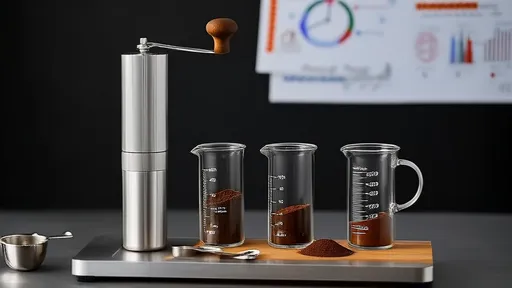
In the world of specialty coffee, the geometry of grinding has emerged as a critical variable influencing extraction dynamics. While much attention is traditionally paid to grind size distribution, the actual shape of the coffee particles—dictated by the burr geometry of the grinder—plays an equally profound, if not more complex, role. Two predominant grinding methodologies, conical and flat burr grinding, represent fundamentally different approaches to fracturing the coffee bean, each imparting a distinct signature on the resulting brew. The divergence in their geometric principles creates a cascade of effects that ultimately dictates the rate and quality of extraction in the cup.
The conical burr grinder operates on a principle of shearing and crushing. Its design features two cone-shaped burrs, one nested inside the other. The beans are fed into the top and are drawn downward through the narrowing gap between the burrs. This creates a progressive crushing action. The geometry of the cut is not uniform; as the beans travel the vertical path, they are fractured at different angles. This often results in a grind particle distribution that contains a wider array of shapes. You find more boulders and fines alongside the target particles. The particles themselves tend to be more blocky and irregular, with fractured, sharp edges. This has a direct impact on the extraction process. The increased surface area of the irregular particles can, in theory, lead to a faster initial extraction. However, the wide distribution of particle sizes creates a challenge: the fines will over-extract, contributing bitterness, while the boulders will under-extract, contributing sourness and a hollow body. The barista must therefore find a balance, often opting for a slightly coarser grind to mitigate the negative effects of the fines, which can paradoxically lead to a lower overall extraction yield if not managed with extreme precision.
In contrast, the flat burr grinder utilizes a slicing and shearing motion between two parallel, horizontally aligned rings of burrs. Beans are fed into the center and are flung outward by centrifugal force through the ever-narrowing gap between the burrs. This action is often described as more scissor-like. The consistent and parallel gap aims to create a more uniform fracture, resulting in a particle distribution that is notably tighter and more consistent. The particles themselves are often more flaky and slab-like, with cleaner cuts. This geometric consistency is the flat burr's greatest advantage for extraction. With a more homogeneous population of particles, each one extracts at a more similar rate. This allows the barista to push the extraction further without as high a risk of simultaneously extracting unpleasant bitter compounds from fines and sour notes from boulders. Consequently, it is often easier to achieve a higher, more even extraction yield with a high-quality flat burr grinder, leading to a cup that can present greater clarity, more distinct flavor separation, and a perceived sweetness.
The impact of these geometric differences extends beyond mere particle size distribution and into the realm of particle morphology, which directly influences the flow of water through the coffee bed. The irregular, blocky particles created by conical burrs can create a more tortuous path for water. The jagged edges can interlock, potentially creating channels where water finds the path of least resistance, or conversely, creating areas of compaction that resist flow. This can lead to uneven extraction within the bed itself. The flaky, consistent particles from flat burrs, however, tend to stack more uniformly. This can create a more predictable and even flow of water, reducing the likelihood of channeling and promoting a more uniform extraction across the entire coffee bed. This is a critical factor in brew methods like espresso, where evenness of extraction is paramount to avoiding sour and bitter notes in the same shot.
Furthermore, the grinding process itself generates heat due to friction. The geometric design influences how much heat is transferred to the coffee grounds. Conical burrs, with their crushing and tearing action, often operate at lower RPMs. The beans spend more time in the grinding chamber but are subjected to less instantaneous friction, potentially generating less heat. Flat burr grinders, especially larger commercial ones, often spin at very high RPMs to maintain centrifugal force. The beans have a shorter residence time but experience intense friction in a very narrow zone, which can generate significant heat. Heat is the enemy of volatile aromatic compounds; it can cause them to dissipate before the coffee even touches water, effectively stripping the grounds of their most delicate and prized flavors before extraction begins. This is a crucial consideration for preserving the nuanced notes of a light-roasted, high-end specialty coffee.
Choosing between conical and flat burr geometries is not a simple matter of declaring one superior to the other; it is about aligning the tool with the desired sensory outcome. The conical burr grinders, often praised for their body and complexity, can produce a cup that feels more blended and syrupy. The wider particle distribution, while a challenge, can also contribute to a sense of depth and richness that some coffee professionals and enthusiasts prefer, especially for milk-based drinks where clarity might be less critical. The flat burr grinders, champions of clarity and precision, excel at revealing the intricate flavor notes inherent in a coffee's origin. They are the preferred tool for those seeking to analyze and showcase the purest expression of a bean, particularly in filter coffee or straight espresso.
Ultimately, the debate between conical and flat burr grinding is a testament to the depth and complexity of coffee extraction. It moves the conversation beyond a one-dimensional focus on grind size and into the fascinating world of particle geometry. Understanding that the very shape of a coffee particle, dictated by the shearing and crushing geometry of the burrs, directly controls its surface area, its interaction with water, and its release of solubles, empowers the brewer to make more informed choices. It is a reminder that in the pursuit of the perfect cup, every detail matters, from the farm to the roaster to the precise mechanical geometry that turns a whole bean into a landscape ready for water to explore.
By /Aug 29, 2025
By /Aug 29, 2025

By /Aug 29, 2025

By /Aug 29, 2025

By /Aug 29, 2025

By /Aug 29, 2025

By /Aug 29, 2025
By /Aug 29, 2025

By /Aug 29, 2025

By /Aug 29, 2025

By /Aug 29, 2025
By /Aug 29, 2025

By /Aug 29, 2025
By /Aug 29, 2025
By /Aug 29, 2025
By /Aug 29, 2025
By /Aug 29, 2025
By /Aug 29, 2025

By /Aug 29, 2025
By /Aug 29, 2025